Streaming Payroll: Why the CFO’s Next Pay Run Will Be On-Chain
The core mission of the corporate treasury is to manage working capital and mitigate financial risk. Yet, the traditional payroll system (a bedrock function of any business) is rigid, slow, and expensive. This legacy infrastructure acts as a major drag on corporate liquidity.
Decentralized finance (DeFi) offers the solution: streaming payroll. By replacing complex, manual batch transfers with smart contracts and regulated stablecoins, companies can transition to a continuous payment model that is more efficient, transparent, and employee-centric.
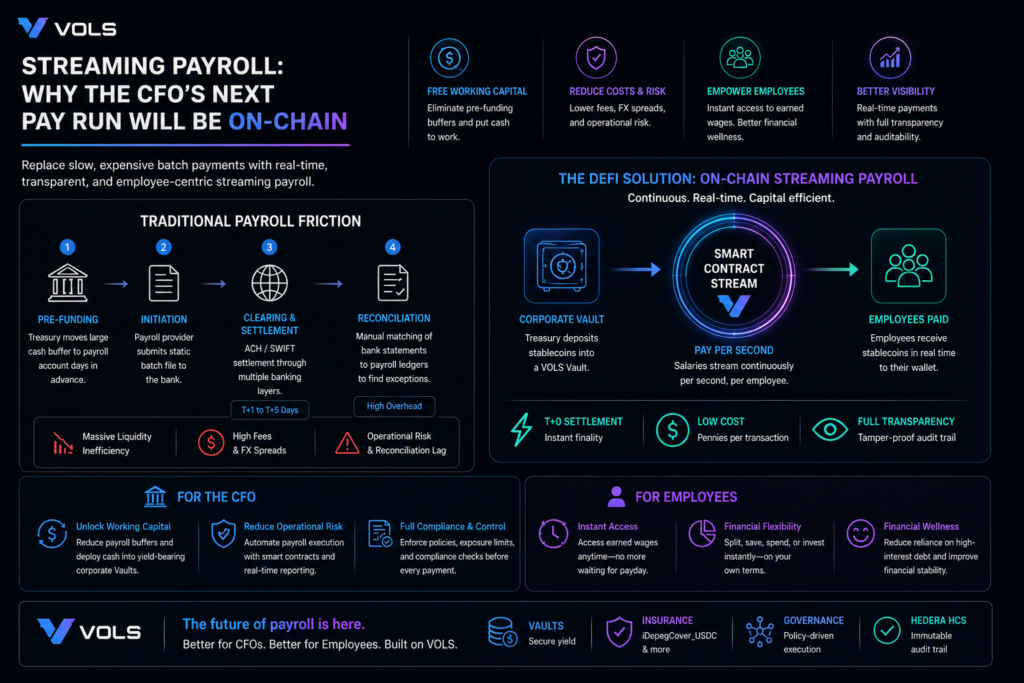
Traditional Payroll Friction
The traditional payroll system is a multi-day, multi-party operation that generates systemic inefficiency, primarily due to the rigid batch transfer model. This process is characterized by an initial capital drag when the Treasury department is forced to execute Pre-Funding, moving a large cash buffer into a dedicated account well in advance of the pay date. The process continues through the Initiation phase, where the payroll provider submits a static batch file to the bank. The critical friction occurs during Clearing & Settlement via ACH or SWIFT, a slow and costly step that typically takes T+1 to T+5 days across multiple banking layers. Finally, the complexity of this flow creates a significant administrative burden, requiring the Finance department to manually perform Reconciliation by matching bank statements to payroll ledgers to detect exceptions. The cumulative result of these manual steps and delays is massive liquidity inefficiency and exposure to high fees, particularly for multinational operations.
The DeFi Solution:
On-chain payroll systems eliminate the need for extensive pre-funding and convert static capital into a dynamically managed asset. It leverages protocols (like Sablier) to set up a continuous stream of stablecoins, paying out salaries per second based on time or performance. This “pay-per-second” model dramatically reduces the size and duration of required payroll buffers, freeing up working capital that can be automatically directed into high-yield, low-risk corporate Vaults until the precise moment it is required (OnChain.org Magazine). As funds are streamed, every payment is an atomic, T+0 transaction instantly logged on a shared ledger. This creates an immediate, tamper-proof audit trail and reduces reconciliation lag time to near zero (insightful.io Blog).
For companies with global, remote teams, stablecoin payroll provides a superior alternative to the correspondent banking system. Companies utilize regulated stablecoins (like USDC) to send funds globally for pennies and in seconds, bypassing the slow, expensive, and opaque friction of SWIFT/correspondent banking (Circle Blog). By using stablecoins, the company gains control over exactly when and where the FX conversion occurs, minimizing the high, unpredictable FX spreads common in traditional cross-border payments.
Financial Sovereignty and Employee Wellness
The advantages of streaming payroll extend directly to the end-user, creating a competitive benefit for employers.
Traditional monthly cycles cause financial stress and reliance on high-interest debt. As noted in research, the lag time contributes to financial instability (SSRN Paper, 2024).
Streaming payroll provides employees with instant access to the value they create, eliminating the need for costly payday loans or short-term credit. Upon receipt, the employee can instantly split their streamed stablecoin between various uses (e.g., 80% to their fiat bank account, 20% into a secure, yield-bearing DeFi Vault), promoting financial discipline and maximizing the utility of their wages.
VOLS positions its infrastructure to automate and de-risk this operational shift. Corporate Treasury Vaults hold the necessary stablecoin buffer, earning safe yield until the funds are streamed. The Insurance Layer can offer protection against risks unique to stablecoins, such as de-peg events (via iAssets like iDepegCover_USDC), ensuring the funds being streamed remain secure. The Governance & Compliance Core ensures all streaming mandates adhere to corporate policies (e.g., maximum exposure limits, compliance checks) before execution.
The transition to on-chain payroll is inevitable. For the CFO, it reduces operational risk and frees capital. For the employee, it unlocks earned wages instantly, improving financial stability and wellness.