Building a 24/7 Global Marketplace
The world’s largest financial markets, from the New York Stock Exchange to the Chicago Mercantile Exchange, are marvels of modern commerce. They rely on a complex web of exchanges, clearinghouses, and prime brokers to facilitate trillions of dollars in daily trading of equities, FX, and derivatives.
This system works, but it’s a product of the 20th century. It’s fragmented, slow, and riddled with inefficiencies that create hidden costs and risks. Trades take days to settle, capital is trapped in siloed accounts, and counterparty risk is a constant concern.
VOLS is engineered to be the institutional-grade infrastructure for a new paradigm: a single, global marketplace that is open 24/7, settles trades instantly, and makes capital radically more efficient.
How Traditional Trading Works Today
For an institution, executing a trade involves a chain of specialized intermediaries, each operating on its own separate ledger. First exchanges like NASDAQ or CME, provide the venue for matching buyers and sellers. Then clearinghouses, mainly the DTCC, act as a central counterparty, guaranteeing the trade to reduce risk, to which prime brokers from the likes of Goldman Sachs and Morgan Stanley provide leverage and manage margin for their clients. Finally custodians like BNY hold the assets in segregated accounts.
This structure is robust, but the coordination required between these players is the source of its greatest weaknesses.
The Traditional Workflow:
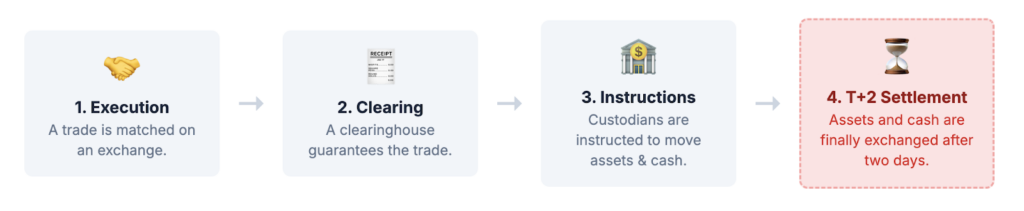
The journey of a single institutional trade from execution to final settlement is a slow, multi-step process that can take up to two days to complete.
The Traditional Workflow in Action:
- Execution: A fund executes a trade on an exchange or through a broker.
- Clearing: The trade details are sent to a clearinghouse, which nets out positions and becomes the buyer to every seller and the seller to every buyer.
- Settlement Instructions: The clearinghouse sends instructions to the respective custodians of both parties to begin the process of exchanging the asset and the cash.
- T+2 Settlement: The actual transfer of the asset and cash often doesn’t happen for two full business days (a process known as T+2). The asset moves on one ledger system, while the cash moves on a completely separate banking ledger.
- Reconciliation: Throughout this period, all parties must manually reconcile their books to ensure everything matches, a process that consumes significant back-office resources.
This workflow is defined by its latency and fragmentation. The delay between trading and settlement creates counterparty risk, while the need for margin in siloed accounts creates a massive capital drag across the financial system.

The 24 hour nature of DeFi:
By tokenizing assets and using a single, shared ledger, DeFi collapses this entire multi-day, multi-intermediary process into a single, instant action.
- Tokenized Assets: All assets ranging from FX pairs (represented as stablecoins like USDC/EURC) to synthetic indexes, are represented as digital tokens on the same network.
- On-Chain Matching & Clearing: A smart contract on the VOLS platform acts as both the exchange and the clearinghouse. It matches orders in real-time according to a transparent set of rules.
- Atomic Settlement: This is the core innovation. The exchange of the asset and the payment happen in the same instant, in one single, indivisible transaction. This is atomic settlement, and it completely eliminates counterparty and settlement risk. The trade is final in seconds, not days (T+0).
- 24/7 Market: The market never closes. There are no settlement windows or reconciliation delays. Liquidity is global and continuous.
VOLS: The Institutional-Grade Exchange Layer

VOLS provides the complete, vertically integrated stack required for this new on-chain marketplace, designed specifically for the security, performance, and compliance needs of institutions. At its core, VOLS is a Central Limit Order Book, providing a transparent and fair trading venue just like a traditional exchange, but built on the high-speed Hedera network for institutional-grade performance and finality.
On VOLS, institutions can use a single pool of tokenized collateral (like tokenized T-Bills) to back their trading activity across all markets, which can be seen as a major step forward in capital efficiency. This breaks down the capital silos of the traditional prime brokerage model.
Every market on VOLS is backed by an integrated insurance layer. Liquidity providers in our vaults not only earn trading fees but also insurance premiums for underwriting the tail risk of the market, turning risk management into a core component of the platform’s yield.
Here are the key benefits of being on-chain:
1. Elimination of Settlement Risk and Counterparty Risk
- Atomic Settlement Finality: On-chain systems execute trades instantly and indivisibly. This eliminates the multi-day “T+2” settlement lag common in traditional finance and on many CEX-based rails, structurally eliminating Herstatt Risk (the risk that one party fails to deliver their side of the trade).
- Self-Custody & Programmability: Funds are held in smart contract vaults, often with institutional multi-sig and programmable policies, rather than being custodied by a centralized entity. This drastically reduces counterparty risk and allows the institution to maintain control over its assets.
2. Enhanced Capital and Collateral Efficiency
- Multi-Asset Cross-Margining: On-chain vaults allow the entire portfolio value—including tokenized Real-World Assets (RWAs) like Gilts or T-Bills—to be used as unified collateral across all open positions. This moves away from isolated margin silos, reducing the required “liquidity buffer” and freeing up capital for active deployment.
- Productive Collateral: Collateral can remain in yield-bearing instruments (like tokenized T-Bills) while simultaneously serving as margin for a trade. The capital is always productive, minimizing Capital Drag.
3. Total Transparency and Auditability
- The “Glass House” Model: Unlike the opaque “black box” nature of a CEX’s internal ledger, on-chain execution ensures that every transaction, collateral movement, and risk parameter is recorded on an immutable ledger with atomic precision.
- Real-Time Regulatory Compliance: This on-chain transparency provides a continuous, high-integrity audit trail for regulators and LPs, who can monitor the real-time health and solvency of the exchange and its vaults, moving beyond the “periodic snapshots” of traditional audits.
4. Algorithmic Execution and Risk Management
- Deterministic Governance: On-chain systems replace manual, subjective oversight with code-based, algorithmic certainty. For example, AI Solver Agents can automatically execute hedging strategies or rebalance the collateral pool the millisecond a risk threshold is crossed, maintaining a strictly risk-neutral posture without human intervention.
24/7 Trading and Liquidity: On-chain markets enable 24/7/365 trading and settlement, even for traditionally illiquid assets like tokenized private credit or sovereign bonds, allowing institutions to manage global liquidity and hedge exposure outside of traditional banking hours.
Putting It Into Practice: A Real-World Scenario
- Setup: Bank A holds tokenized Euros (EURC) and Fund A holds digital dollars (USDC). Both are verified institutions on the VOLS platform.
- Execution: Bank A places an order to sell EURC for USDC on the VOLS CLOB. Fund A has an opposing order.
- Settlement: The VOLS smart contract instantly matches the orders and executes an atomic swap. The EURC and USDC are exchanged between the two parties’ digital wallets in a single transaction. The trade is cleared and settled in seconds.
- Efficiency: The entire process bypasses the slow and costly traditional correspondent banking and CLS (Continuous Linked Settlement) systems, saving both parties time and reducing capital costs.
The Strategic Imperative
The future of financial markets is unified, tokenized, and real-time. The inefficiencies of the T+2 settlement world are a relic of a past technological era. By building the first truly institutional-grade exchange layer that combines a high-performance CLOB with integrated insurance and cross-market margin, VOLS is providing the essential infrastructure for a faster, safer, and radically more capital-efficient global marketplace.
VOLS offers institutions a unique opportunity: the ability to access on-chain yield, execution, and governance, without surrendering control, transparency, or risk management.
It’s the first DeFi-native infrastructure to bring together:
- The execution discipline of a regulated exchange
- The flexibility of programmable liquidity strategies
- The safety of native insurance and governance
Trade now on https://beta.vols.fi/trade/WHBAR-WBTC