Fund Tokenization on VOLS
In the financial world, some of the most valuable assets are also the most difficult to trade. Think of the cash flows from a corporate bond, the revenue from a portfolio of solar farms, or the future royalties of a hit song. These are powerful, income-generating assets, but they are fundamentally illiquid. They are locked in complex legal structures, making them slow and expensive to buy or sell.
Securitisation is the traditional process for trying to solve this. It involves packaging these cash-flowing assets into securities that can be sold to investors. While a multi-trillion dollar market, it is a process burdened by paper-based, 20th-century workflows.
VOLS is providing the infrastructure for a fundamental upgrade. By tokenizing these assets and providing a dedicated secondary marketplace, we are poised to unlock liquidity for a new universe of real-world assets and create a true “market for everything.”
What is Securitisation?
Think of securitisation as creating a financial fruit basket. An originator takes individual, hard-to-sell assets (like a single apple or orange) and packages them together into an attractive basket that is easy to buy and sell.
In finance, this means taking illiquid assets, like a bundle of corporate loans, and packaging them into different “slices” or tranches, each with a different risk and return profile, that can be sold to institutional investors. In theory, it’s a brilliant way to create liquidity. In practice, the process is a slow and costly ordeal.
The Traditional Workflow:
The traditional path from raw asset to tradable security involves a long chain of intermediaries, each adding time, cost, and complexity.
The Traditional Workflow in Action:
- Origination & Packaging: An issuer (e.g., a bank) originates assets (e.g., mortgages or invoices) and sells them into a Special Purpose Vehicle (SPV), a costly and complex legal entity created just to hold them.
- Structuring & Tranching: An investment bank structures the deal, creating different risk tranches (e.g., senior, mezzanine, junior) that are sold to investors.
- Manual Servicing: An administrator manually collects payments, manages defaults, and calculates the complex “waterfall” of distributions to the different tranches.
- Opaque Reporting: Investors receive periodic PDF reports, often only monthly or quarterly, with limited real-time insight into the performance of the underlying assets.
- Illiquid Secondary Market: This is the critical failure point. Selling a tranche is incredibly difficult. It requires finding a buyer OTC and using a slow, manual transfer agent to record the change of ownership, a process that can take days or weeks. There is no central, liquid marketplace.
A New, Liquid Workflow
Tokenization collapses this entire fragmented pipeline into a single, automated, and transparent process on one ledger.
The DeFi-Powered Workflow on VOLS:
- Asset Digitization (Tokenization): Every underlying asset, from a corporate bond to a royalty agreement, is represented as a digital token. Its legal rights and performance data are embedded or linked to it digitally.
- Smart Contract as SPV: A smart contract replaces the expensive legal SPV. It’s a transparent, automated vehicle that pools the asset tokens and executes the rules of the securitisation—like the payment waterfall—flawlessly and in real time.
- Automated Distribution: As cash flows come in from the underlying assets, the smart contract automatically streams the pro-rata payments to the digital wallets of the tranche token holders.
- 24/7 Liquid Secondary Market: This is the revolution. An institution holding a senior tranche token can instantly sell it on the VOLS on-chain order book at any time. What was once illiquid is now instantly tradable.
VOLS: The Institutional-Grade Infrastructure for Tokenized Strategies
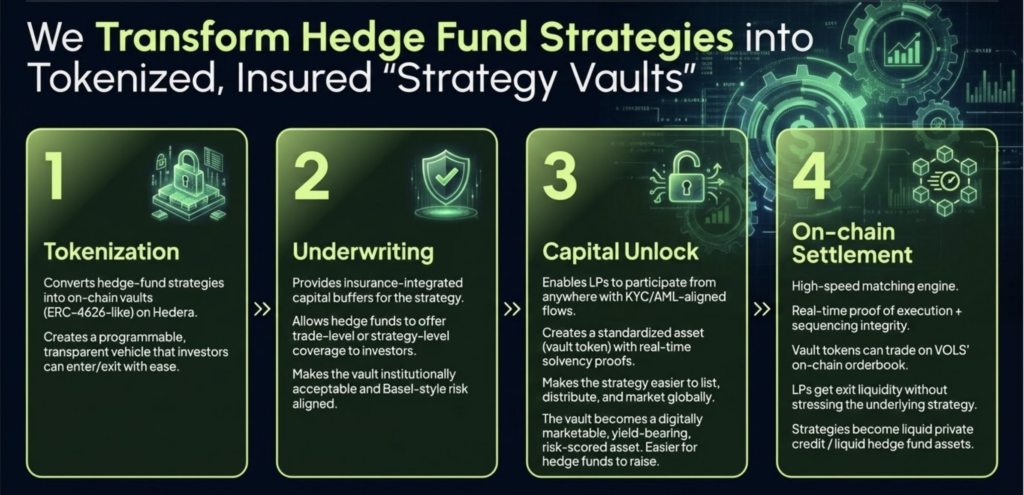
This powerful new market requires purpose-built infrastructure to function at scale. VOLS provides the essential layers for a solvent, liquid, and secure on-chain Strategies Market. The VOLS Central Limit Order Book is the engine of liquidity for this new ecosystem.
It provides a 24/7, institutional-grade venue for these newly created tranche tokens to be traded, enabling continuous price discovery for the first time.
Tokenisation is all about slicing and managing risk. The VOLS Solvency Layer makes this programmable. Institutions can underwrite or purchase protection against specific risks within a deal (like default or extension risk), tokenizing this protection into a tradable iAsset. This provides a powerful new tool for on-chain hedging.
VOLS provides a robust compliance framework. Access to these markets can be restricted to verified (KYB’d) institutions, and complex rules (like transfer restrictions or lock-up periods) can be embedded directly into the tokens themselves, automating compliance.
A Real-World Scenario
- Tokenization: A Fortune 500 company issues a tokenized 5-year corporate bond.
- On-Chain tokenisation: A VOLS-compatible smart contract automatically tranches the bond into Senior, Mezzanine, and Junior tokens.
- Secondary Trading: All three tranche tokens are listed on the VOLS CLOB. A market maker provides continuous liquidity for the Senior/USDC pair.
- Hedging: An insurance fund, concerned about potential default, buys protection from a VOLS insurance vault. This protection is issued as an iDefault Cover token, which is itself tradable.
- Outcome: The bond’s risk is now transparently priced, liquid, and hedgeable in a single, unified on-chain venue.
The Strategic Imperative
The ability to tokenize and trade any cash-flowing asset is the next great frontier in finance. The market for tokenised products is measured in the trillions, but it has been held back by illiquidity and inefficiency. By providing the core infrastructure for secondary trading and on-chain risk management, VOLS is building the foundation for a more transparent, efficient, and vastly larger market for real-world assets.
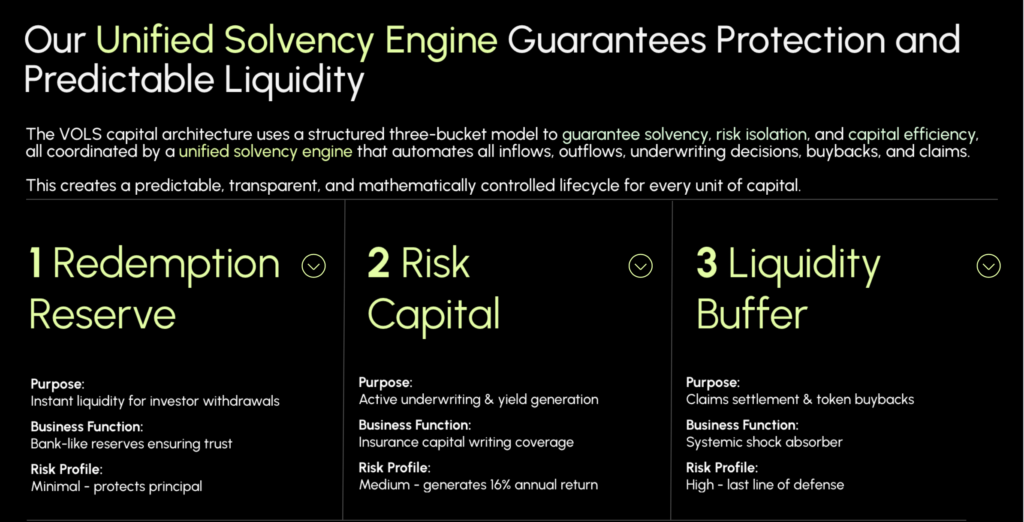
VOLS offers institutions a unique opportunity: the ability to access on-chain strategies, execution, and governance, without surrendering control, transparency, or risk management.
It’s the first DeFi-native infrastructure to bring together:
- The execution discipline of a regulated exchange
- The flexibility of programmable liquidity strategies
- The safety of native insurance and governance