
For any Chief Financial Officer (CFO) at a global company, the treasury department is a source of constant, low-grade anxiety. Their world is a complex mess of trapped capital, time zones, and counterparty risk.
They manage dozens of bank accounts across different countries, holding idle cash buffers to meet payroll. They lose millions to FX (foreign exchange) fees when paying international suppliers. They wait T+2 days for critical settlements, all while their teams manually reconcile a tangled web of SWIFT messages and bank statements.
DeFi, and specifically institutional-grade infrastructure like VOLS, offers a complete redesign. It transforms the corporate treasury from a static cost center into a programmable, efficient, and even yield-bearing strategic asset.
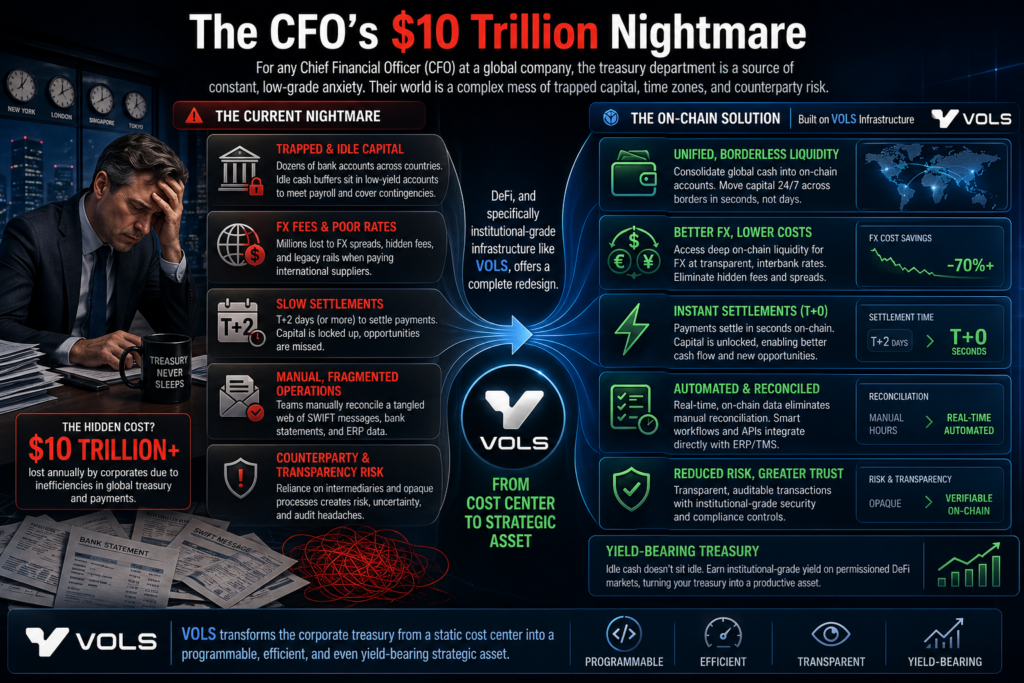
Let’s break down the problems and the on-chain solutions.
Problem 1: Fragmented, Slow, & Expensive Payments
A UK-based company needs to pay a supplier in Japan. The CFO instructs their bank to send a SWIFT payment. This payment routes through a “correspondent banking” chain, from the UK bank, to a US dollar clearing bank, to a Japanese bank, with each intermediary taking a fee and adding days to the settlement time. The FX rate is often opaque and uncompetitive, and the final settlement can take 3-5 business days.
With on-chain infrastructure, the CFO bypasses this entire chain. He would use an on-chain order book to execute a direct, transparent and real-time FX trade (e.g., swapping tokenized Pounds (GBPC) for tokenized Yen (JPYC) or routing through USDC). The tokenised currency is instantly transferred to the supplier’s digital wallet. While the entire transaction, that being the FX conversion and final payment, is settled in seconds and for a fraction of the cost.
This is atomic settlement: the exchange and payment happen in a single, indivisible step, 24/7, eliminating counterparty risk and freeing up cash flow.
Problem 2: Trapped Working Capital
The company must hold large, idle cash balances in multiple currencies to manage payroll, pay suppliers, and handle unexpected expenses. This cash sits in low- or zero-yield accounts, a dead weight on the balance sheet. Payroll is a clunky, bi-weekly or monthly batch process that requires significant pre-funding.
On-chain, idle capital becomes productive. Instead of large, bi-weekly payroll batches, the CFO can use smart contracts to stream salaries to employees in real-time. This “T+0 payroll” drastically reduces the need for large, idle payroll buffers. For M&A deals or large purchases, funds are placed in a smart escrow contract, not a bank’s holding account. The funds are released automatically and instantly once an oracle (a real-world data feed) confirms delivery or contract terms are met. Idle treasury funds can be automatically swept into low-risk, institutional-grade yield Vaults on VOLS, such as those holding tokenized T-Bills, allowing the company’s cash to earn a safe return until the moment it’s needed.
Problem 3: Opaque Processes & High-Risk Intermediaries
The traditional system is opaque. The treasury team spends significant time manually reconciling statements from multiple banks. For critical functions like escrow, they must trust a third-party agent, introducing another layer of cost and risk.
A blockchain acts as a single, shared, immutable ledger. All transactions (payments, FX, yield) are recorded on-chain. There is only one “source of truth,” which eliminates the need for manual reconciliation entirely. Furthermore the smart contract replaces the escrow agent. Its rules are written in code, auditable by all parties, and executed automatically, removing intermediary risk. Finally for critical settlements, the CFO can use the VOLS Insurance Layer to purchase protection against specific risks (like operational failure or de-pegging events), managing risk programmatically.
How VOLS Powers the New Corporate Treasury
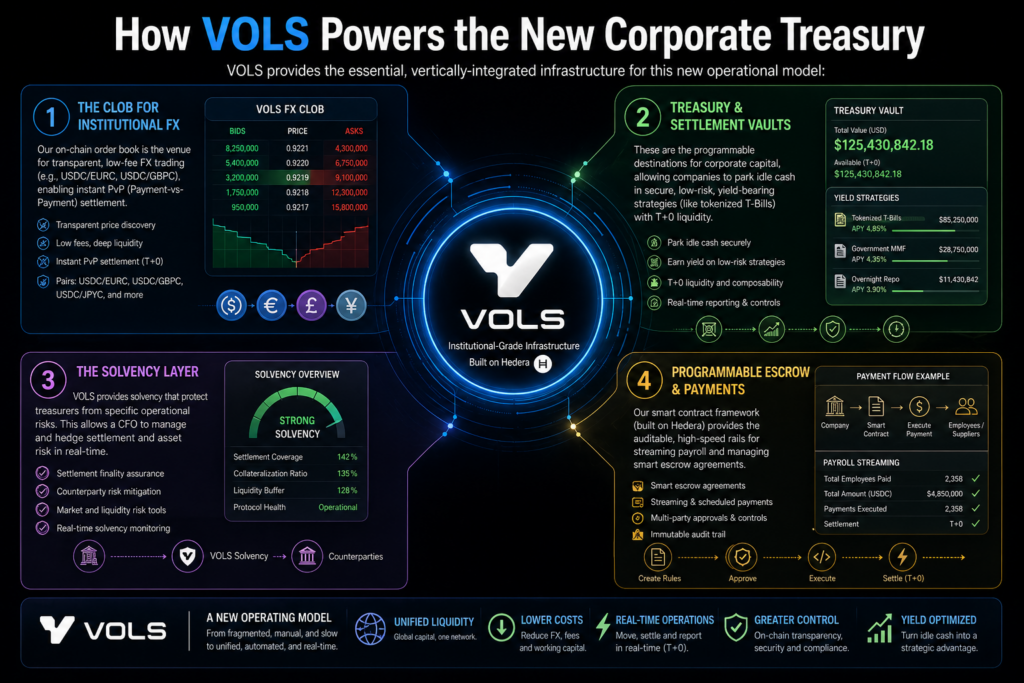
VOLS provides the essential, vertically-integrated infrastructure for this new operational model:
- The CLOB for Institutional FX: Our on-chain order book is the venue for transparent, low-fee FX trading (e.g., USDC/EURC, USDC/GBPC), enabling instant PvP (Payment-vs-Payment) settlement.
- Treasury & Settlement Vaults: These are the programmable destinations for corporate capital, allowing companies to park idle cash in secure, low-risk, yield-bearing strategies (like tokenized T-Bills) with T+0 liquidity.
- The Solvency Layer: VOLS provides solvency that protect treasurers from specific operational risks. This allows a CFO to manage and hedge settlement and asset risk in real-time.
- Programmable Escrow & Payments: Our smart contract framework (built on Hedera) provides the auditable, high-speed rails for streaming payroll and managing smart escrow agreements.
The Strategic Imperative:
This is more than an upgrade. It’s a fundamental transformation of the corporate treasury from a high-friction cost center into a strategic, automated, and capital-efficient component of the business.
VOLS offers institutions a unique opportunity: the ability to access on-chain yield, execution, and governance, without surrendering control, transparency, or risk management.
It’s the first DeFi-native infrastructure to bring together:
- The execution discipline of a regulated exchange
- The flexibility of programmable liquidity strategies
- The safety of native insurance and governance