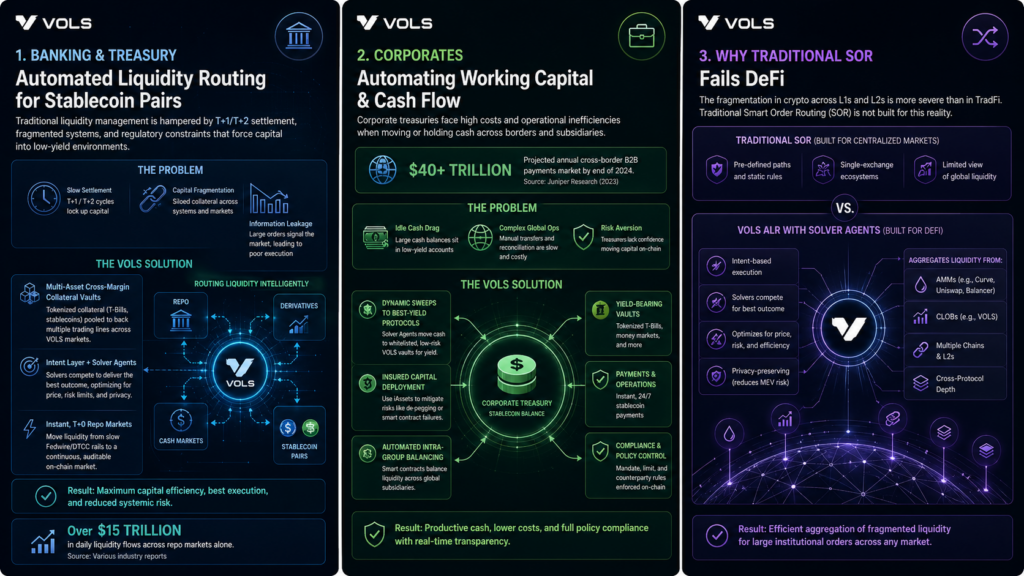
The global institutional finance system is filled with capital drag. Money can be locked in slow settlement cycles, isolated silos, and non-productive accounts. This inefficiency is not a small problem; it affects over $15 trillion in daily liquidity flows across repo markets alone .
The solution is not merely faster payments, but Automated Liquidity Routing (ALR): the algorithmic process of finding the optimal path and price for capital movement. VOLS provides the institutional capabilities to solve this, transforming static collateral and trapped cash into programmable, high-velocity liquidity.
Banking & Treasury
Traditional liquidity management is hampered by T+1/T+2 settlement, fragmented systems, and regulatory constraints that force capital into low-yield environments. On-chain solutions offer real-time optimization, security, and efficiency.
In the traditional system, capital posted as collateral is siloed. Moreover, any large order critical for managing large block liquidity risks information leakage. Therefore signaling the market and leading to poor prices, a core concern identified in institutional trading (Smart Trade Group, 2016).
The VOLS Solution
VOLS leverages advanced routing and integrated risk controls to maximize capital utility. One tool we have at our disposal are Multi-Asset Cross-Margin Collateral Vaults. They hold tokenized collateral (e.g., T-Bills, stablecoins) from various sources. Institutions can leverage this single pool to back multiple trading lines across different VOLS markets (repo, derivatives). This dramatically improves capital efficiency by reducing the overall margin required, solving the fragmentation problem.
VOLS also uses an Intent Layer combined with competitive Solver Agents. Unlike traditional Smart Order Routers (SORs) that follow pre-defined transactional paths (Deeplink Labs, 2022), VOLS Solvers compete to deliver the best outcome, optimizing for complex goals like price and adherence to pre-set risk limits, thereby addressing the MEV (Maximal Extractable Value) and information leakage risks associated with large orders.
By tokenizing high-quality collateral, VOLS enables instant, T+0 repo markets, moving liquidity off the slow Fedwire/DTCC rails and into a continuous, auditable market. For a more in-depth look at on-chain repo markets we have a post dedicated to this on our page.
Why Traditional Standard Order Routing Fails DeFi
The fragmentation in crypto across L1s and L2s is more severe than in TradFi (NADCAP, 2023). Traditional SOR is designed for single-exchange ecosystems. DeFi ALR, especially through Solvers, is the only mechanism that can efficiently aggregate depth from multiple protocols (AMMs like Curve, CLOBs like VOLS) and chains, a necessity for large institutional orders.
Corporates: Automating Working Capital & Cash Flow
Corporate treasuries manage global operations, facing high costs and operational inefficiencies when moving or holding cash. The global cross-border B2B payments market is projected to exceed $40 trillion annually by the end of 2024 (Juniper Research, 2023)..
Multinational corporations are forced to keep substantial sums in low-yielding local bank accounts to cover operational needs. This idle cash is static, failing to keep pace with the high hurdle rate of investment returns and representing a missed opportunity for yield (Ditto Network, 2024).
The VOLS Solution
VOLS turns passive corporate cash into a dynamically managed, productive asset.
Firstly one feature we can implement is dynamic treasury sweeps to best-yield protocols, it allows for corporate cash (held as regulated stablecoins) to be automatically “swept” by a Solver Agent from low-interest operational wallets into whitelisted, low-risk VOLS Vaults offering yield (e.g., tokenized T-Bills). This process, driven by automated liquidity management algorithms (Ditto Network, 2024), ensures cash is earning a competitive return until the moment it is needed for payment.
Secondly, to overcome the risk aversion associated with moving capital on-chain, VOLS integrates the Insurance Layer to have insured capital deployment. Treasurers can purchase iAssets (insured tokens) to mitigate specific risks like stablecoin de-pegging or smart contract failure. This backstop enables treasury managers to confidently participate in automated yield strategies that they would otherwise deem too risky.
Thirdly, automated intra-group liquidity balancing lets smart contracts programmatically balance stablecoin pools across subsidiaries globally. This eliminates complex, costly, and manual interbank transfers and reconciliation, optimizing cash flow across the entire corporate entity.
Technical Rationale
The key technical advantage for Corporates is policy adherence. VOLS uses its Governance & Compliance Core to ensure that automated liquidity movements adhere to corporate mandates (e.g., maximum exposure limits, specific counterparty whitelists) before execution. This level of programmable control is the fundamental difference required to attract vast corporate treasuries into the DeFi ecosystem.