
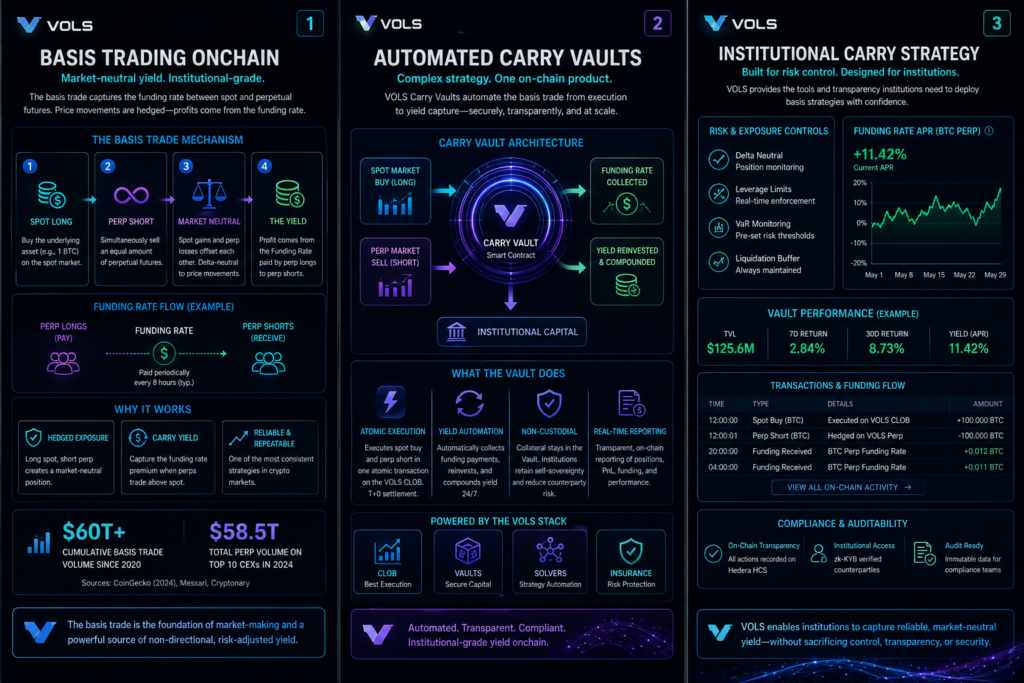
The Basis Trade is one of the most reliable and fundamental market-neutral strategies used by institutional hedge funds and proprietary trading desks worldwide. The market’s cumulative trading volume has surpassed $60 trillion since 2020. Its migration to decentralized finance, powered by automated Carry Vaults, represents a major leap toward providing institutional-grade yield and efficiency on-chain. This is a strategy designed to generate predictable, low-risk returns by exploiting the inherent relationship between a spot asset’s price and its corresponding derivative contract. The perpetual futures market is immense as the total volume for Top 10 CEXs was $58.5 trillion in 2024 (CoinGecko, 2024). Furthermore perps average daily volume is often 3x larger than the spot market, alongside this the activity is driven by both speculation and institutional hedging, particularly since US spot Bitcoin ETF approvals boosted institutional interest in regulated derivative hedging tools
Understanding the Basis Trade
At its core, the basis trade is a form of arbitrage that relies on the temporary pricing difference, or “basis,” between two contracts for the same asset (Investopedia, Cube Exchange).
The Core Mechanism
- Spot Position: The investor buys the underlying asset (e.g., buys 1 BTC).
- Hedged Position: Simultaneously, the investor sells a Perpetual Futures Contract (perp) for the same amount of the same asset (e.g., sells 1 BTC perp).
- Market Neutrality: Because the investor is long (owns) the spot asset and short (sells) the perp, the position is market-neutral. Price movements in the underlying asset are offset by corresponding gains/losses in the derivative contract.
- The Yield: The profit comes exclusively from the Funding Rate—a periodic payment exchanged between long and short traders to keep the perp price tethered to the spot price. When the perp contract trades at a premium to the spot price (which is common in bullish crypto markets), short traders pay long traders. The basis trader, holding a net short perp position, receives this funding rate.
The basis trade is the foundation of many market-making strategies because it generates a passive carry yield from market demand, largely independent of directional market movements (Messari, Cryptonary).
The Institutional Problem
In traditional centralized finance, executing the basis trade at scale is resource-intensive and carries friction. The nature of basis trading is that it requires manual execution. Coordinating the simultaneous spot purchase and derivative short requires complex API integration and active risk management. Furthermore the collateral is typically held on a centralized exchange (CEX) which incurs counterparty risk. The institutional fund is exposed to the operational and custody risks of that third party, as evidenced by major exchange failures. In addition to the counterparty risk, managing collateral on CEX platforms fragments capital, limiting the ability to instantly re-deploy those funds across other strategies.
Automated Carry Vaults
VOLS solves these challenges by packaging the complex, multi-step basis strategy into a single, compliant, and auditable on-chain product: Carry Vaults.
A. Security and Automation
VOLS Vaults are secure, programmable smart contracts designed to hold and manage institutional capital (Apex Exchange, James O. Be). The carry vault automates the core transaction: it executes the spot buy and the simultaneous perp short in one atomic (indivisible) transaction on the VOLS CLOB. This ensures instant T+0 settlement and eliminates execution risk. Then, the smart contract automatically harvests the funding rate yield, reinvests it, and reports the return in real-time. This turns a complex, manual strategy into a passive, yield-generating investment suitable for institutional allocation. While the collateral is held in the non-custodial Vault, meaning the institution retains self-sovereignty over their assets (Casa, 2021), mitigating the counterparty risk inherent in centralized exchange funding pools.
B. The Policy & Compliance Layer
For institutions, the biggest benefit is risk control and compliance. Our solver agents who govern the vaults are programmed with strict risk policies. They monitor real-time leverage and exposure, ensuring the strategy remains market-neutral and adheres to pre-set Var (Value-at-Risk) limits. Alongside the solvers we can provide real time auditability. Every transaction from the initial spot/perp pairing, the collateral movements, and every funding rate payment, is logged on the immutable ledger (Hedera HCS), providing auditable proof of the strategy’s market neutrality to compliance teams. Furthermore, carry vaults become a building block for capital efficiency. The collateral inside the Vault can be simultaneously leveraged for cross-market margin, maximizing the utility of the institution’s stablecoin holdings.
Strategic Outcome
On-chain basis trading via automated Carry Vaults transforms a high-friction strategy into a liquid, transparent, and policy-compliant asset. This innovation directly attracts institutional capital seeking reliable, risk-adjusted yield that is structurally insulated from directional market volatility, serving as a powerful component of the institutional DeFi ecosystem VOLS is building.