The previous pillars in this series focused on rebuilding traditional finance; making repo, credit, and trading faster, cheaper, and more transparent. This final pillar is about what comes next: building entirely new financial instruments that are impossible in the old world.
We are moving from a system of “batch-processed” finance, limited by 9-to-5 markets and manual intervention, to a world of autonomous, real-time, and programmable value. Artificial Intelligence alone is projected to deliver up to $1 trillion in additional value to the global banking industry annually . This value won’t come from just optimizing old processes; it will come from creating new ones.
VOLS is not just a market; it’s an institutional innovation lab. Our vertically integrated stack provides the secure, compliant “operating system” for this new generation of finance.
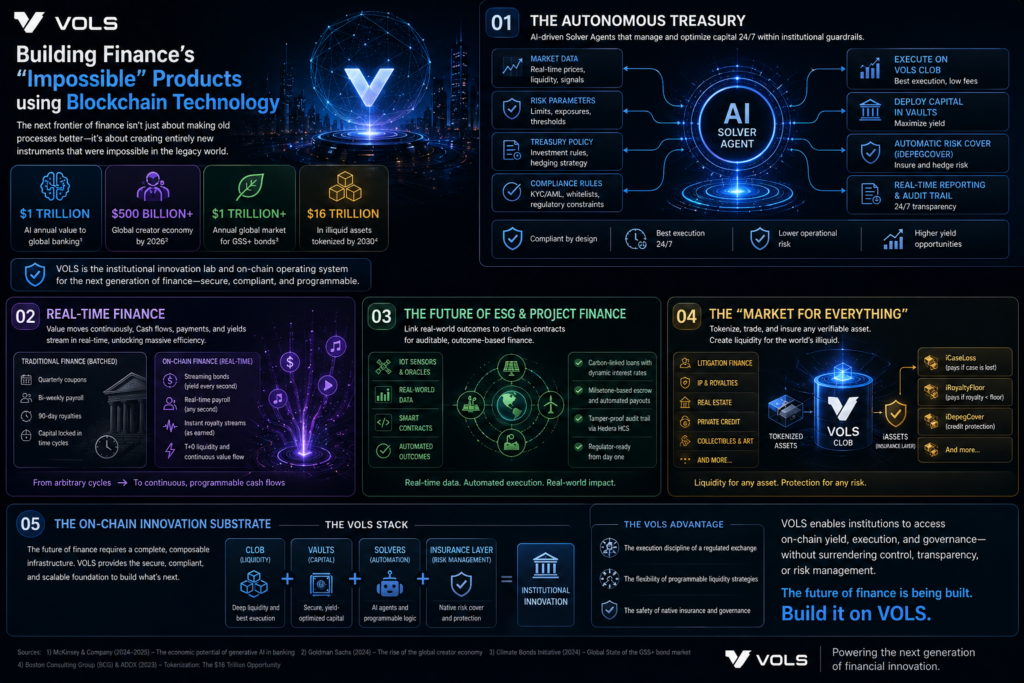
The Autonomous Treasury
In tradfi a corporate or fund treasury is managed by humans operating on spreadsheets and terminal commands. In a 24/7 global market, this is a 24/7/365 risk. A treasury manager can’t rebalance a portfolio or hedge an FX exposure at 3 AM on a Sunday when a market moves.
AI Solver Agents
The VOLS architecture is built for AI-driven Solver Agents. These are autonomous, on-chain bots designed to execute complex strategies within pre-defined institutional guardrails.
One of which is that it is compliant by design. An institution can deploy a solver agent that is bound by smart contract rules. For example, it can be programmed to “automatically sweep idle cash into the highest-yielding insured T-Bill vault, maintain a 30% hedge on EURC exposure, and never transact with an unvetted counterparty.”
At VOLS we integrate the solver agents that use the VOLS CLOB for best execution, the vaults as their capital base, and the insurance layer to automatically purchase risk cover (like iDepegCover) as required by their policy. This is a 24/7, autonomous, and compliant treasury, managed by AI.
Real-Time Finance
Traditional financial instruments are “batched.” A bond pays a coupon quarterly. An employee is paid bi-weekly. A royalty check arrives 90 days after the end of the quarter. This is a massively capital-inefficient model that locks up value in arbitrary time cycles.
On-chain, value can move continuously. Why wait 90 days for a coupon? An institution can issue a “streaming bond” on VOLS that pays its yield to token holders every second. This provides investors with real-time cash flow and programmable, T+0 liquidity.
The global creator economy, projected to exceed $500 billion by 2026, is plagued by delayed payouts. Using VOLS infrastructure, a media company can tokenize a royalty stream (for music, film, etc.) that automatically streams revenue to artists and investors as it’s earned, with 100% transparency.
The Future of ESG & Project Finance
The global market for sustainable “Green Bonds” has surpassed $1 trillion annually, but it’s plagued by “greenwashing.” Investors provide capital based on a promise, with verification happening manually, months later. It’s impossible to programmatically link funding to real-world outcomes.
VOLS infrastructure can directly connect on-chain contracts to real-world data via oracles to provide parametric ESG & milestone-based finance
An institution can issue a “Carbon-Linked Loan” in a VOLS Vault. An IoT sensor (via an oracle) can feed data (“solar farm produced X MWh” or “carbon capture plant sequestered Y tons”) directly to the smart contract. If the target is met, the interest rate automatically drops.
For a construction or infrastructure project, a smart contract can hold funds in escrow and automatically release payments as oracles verify each milestone is completed (e.g., “Foundation poured,” “Permit approved”).
This is auditable, real-time, outcome-based finance. The Hedera Consensus Service (HCS) provides an immutable audit trail, making this process regulator-ready from day one.
The “Market for Everything”
A vast world of alternative assets like litigation finance, art orIP rights are completely illiquid and un-hedgeable. The reason for this is most likely because they are only accessible to a few niche funds. The VOLS stack can create liquid markets for any verifiable asset. We can tokenize, trade, and insure Any Risk. A litigation finance firm can tokenize its stake in a portfolio of legal cases and sell tranches on the VOLS CLOB. How does an investor hedge this? They can buy a specific iAsset from our Insurance Layer… for example, an iCaseLoss token that pays out if the court case is lost, or an iRoyaltyFloor token that pays out if a song’s royalty stream drops below a certain level.
The Strategic Imperative: The On-Chain Innovation Substrate
The first wave of DeFi proved the technology. The next, as projected by firms like BCG, will see up to $16 trillion in illiquid assets tokenized by 2030.
This new world requires more than just a marketplace; it needs a complete financial operating system. VOLS is that substrate. Our integrated stack of a CLOB (for liquidity), Vaults (for capital), Solvers (for automation), and the Insurance Layer (for risk management) provides the secure, compliant, and composable foundation for institutions to not only participate in the future of finance, but to build it.
VOLS offers institutions a unique opportunity: the ability to access on-chain yield, execution, and governance, without surrendering control, transparency, or risk management.
It’s the first DeFi-native infrastructure to bring together:
- The execution discipline of a regulated exchange
- The flexibility of programmable liquidity strategies
- The safety of native insurance and governance
Sources: (1) Based on 2024-2025 analysis from firms like McKinsey & Company on the value of AI in global banking. (2) Projections from Goldman Sachs and other market analysts on the growth of the global creator economy. (3) Data from the Climate Bonds Initiative (CBI) on the size of the GSS+ (Green, Social, Sustainability) bond market. (4) Widely-cited 2023 joint report from Boston Consulting Group (BCG) and ADDX on the future market size of asset tokenization.