
AML on the Chain: Reactive Forensics to Real-Time Financial Intelligence
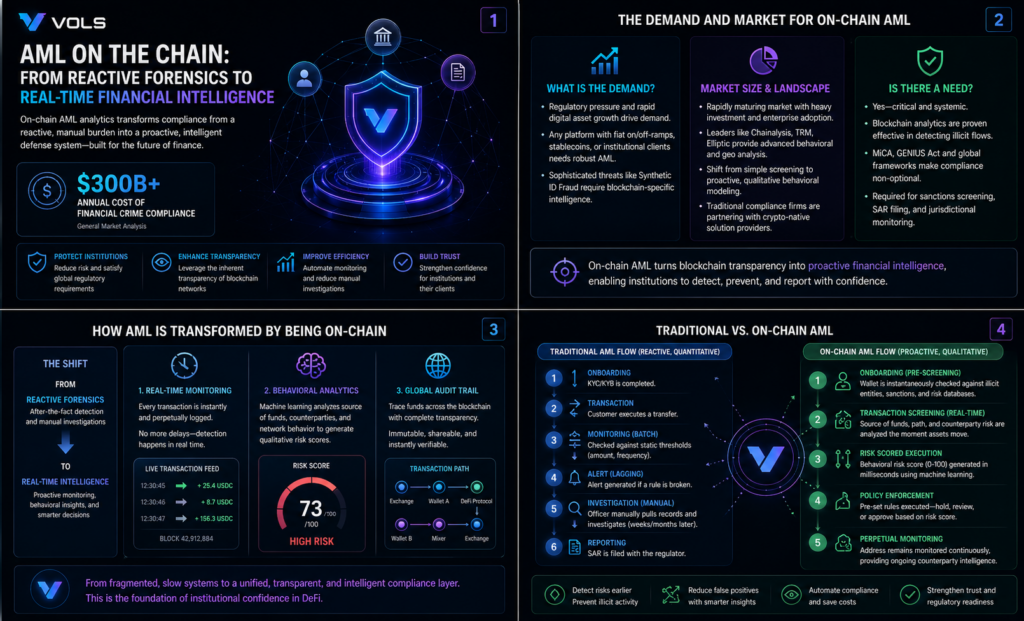
For institutional finance, the greatest barrier to entering the DeFi ecosystem has long been the perception of unchecked anonymity and compliance risk. Anti-Money Laundering (AML) is not just a regulatory hurdle; it is a projected $300 billion annual cost for financial institutions (General Market Analysis), a cost that often fails to prevent financial crime effectively.
The shift to on-chain AML analytics (often integrated with tools like Chainalysis, TRM, and Elliptic) transforms this obligation from a reactive, manual burden into a proactive, intelligent defense system.
The Demand and Market for On-Chain AML
What is the current demand for on-chain AML?
The demand is driven by regulatory pressure and the explosive growth of the digital asset market. Any platform dealing with fiat-to-crypto on/off-ramps, regulated stablecoins, or institutional client assets must have robust AML controls.
As institutional capital (ETFs, corporate treasuries, RWA issuers) enters the space, the demand for enterprise-grade, high-confidence compliance tools becomes non-negotiable. Furthermore, the rise of sophisticated threats like Synthetic ID Fraud requires the new, more specific data offered by blockchain analytics (Crypto Express/Crowe Insights).
What is the market like, and what is its size?
The market is rapidly maturing and experiencing heavy investment. The industry has moved beyond basic tools to established compliance giants (Chainalysis, TRM) offering highly sophisticated behavioral and geographical analysis. The focus is also shifting from simple sanction screening to proactive, qualitative behavioral modeling (Acuity Knowledge Partners). In addition to the product shift, traditional compliance giants are actively partnering with crypto native solution providers to bridge the gap. The goal is to move from generalized analytics to tailored financial crime programs that leverage the unique transparency of the blockchain (Crowe Insights).
Is there a need for it?
Yes, the need is critical and systemic. While transparent, blockchain networks are still used for illicit financial flows. Studies confirm that blockchain analytics are effective in detecting these flows, proving that the technology is a superior defense mechanism when applied correctly (ResearchGate, 2024). As MiCA, the Genius Act, and other global frameworks solidify, compliance is no longer optional. On-chain AML is necessary to satisfy legal requirements related to sanctions screening, Suspicious Activity Report (SAR) filing, and jurisdictional monitoring.
How AML is Transformed by Being On-Chain
The core benefit of integrating AML with the blockchain is the shift from the limitations of the traditional system to the proactive intelligence of the on-chain model.This transformation is based on three core benefits. First, while traditional compliance is plagued by delayed discovery due to reliance on periodic reports and manual reconciliation, on-chain AML provides real-time monitoring because every transaction is instantly and perpetually logged. Second, the reliance of legacy AML on static thresholds (simple quantitative limits easily gamed by criminals) is replaced by behavioral analytics, utilizing machine learning to generate qualitative risk scores based on source of funds and counterparty network history. Finally, the ability to trace funds across the blockchain creates a global audit trail, overcoming the fundamental limitation of fragmented systems where tracing illicit flows across multiple siloed bank ledgers is complex and slow. This move from reactive forensics to proactive, real-time financial intelligence is critical for institutional confidence.
Traditional vs. On-Chain AML
The difference between traditional AML and blockchain AML is the shift from reactive, post-transaction investigation to proactive, pre-transaction screening and real-time behavioral monitoring.
Traditional AML Flow (Reactive, Quantitative)
- Onboarding: KYC/KYB is completed.
- Transaction: Customer executes a transfer.
- Monitoring (Batch): An internal system checks the transaction data against static thresholds (e.g., amount, frequency).
- Alert (Lagging): An alert is generated if a static rule is broken.
- Investigation (Manual): A compliance officer manually pulls records and investigates (weeks/months later).
- Reporting: SAR is filed with the regulator.
On-Chain AML Flow (Proactive, Qualitative)
- Onboarding (Pre-Screening): The customer’s wallet address is instantly checked against databases for known illicit entities (sanctions, dark market linkage).
- Transaction Screening (Real-Time): The moment an asset is moved, the analytics platform (e.g., Chainalysis, TRM) analyzes the source of funds, the transaction path, and the counterparty’s risk score.
- Risk Scored Execution: Instead of a simple pass/fail, a behavioral risk score (e.g., 0-100) is generated, often utilizing machine learning to identify patterns indicative of illicit activity. This can happen in milliseconds.
- Policy Enforcement: Platforms like VOLS use this score to execute pre-set rules—e.g., automatically placing a hold, flagging the transaction for manual review, or allowing it to proceed if the risk is low.
- Perpetual Monitoring: The address remains monitored even after the transaction is complete, providing ongoing intelligence on counterparty risk.
This shift ensures that high-risk activity can be flagged and potentially prevented before it is finalized on the ledger, offering a level of control and intelligence impossible within the fragmented, slow traditional banking world.