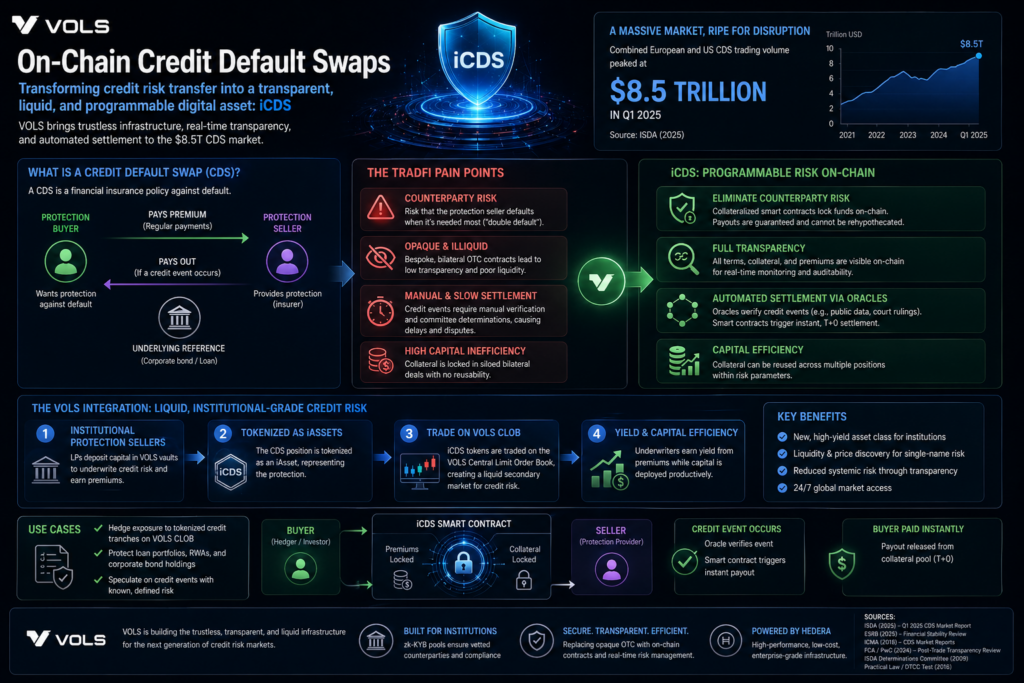
The management of credit risk is one of the most critical functions in the global financial system. The primary tool for this is the credit default swap, it is an immense market, with combined European and US trading volume peaking at $8.5 trillion in Q1 2025 (ISDA, 2025). Yet, this essential market remains hampered by the same vulnerabilities exposed during the 2008 crisis: opacity, counterparty risk, and fragmentation. VOLS has the power to transform the CDS from a complex, bilateral OTC contract into a trustless, liquid, and programmable digital asset (iCDS). Our native Insurance Layer brings transparency and security to credit risk transfer, something impossible in the traditional world.
What is a Credit Default Swap (CDS)?
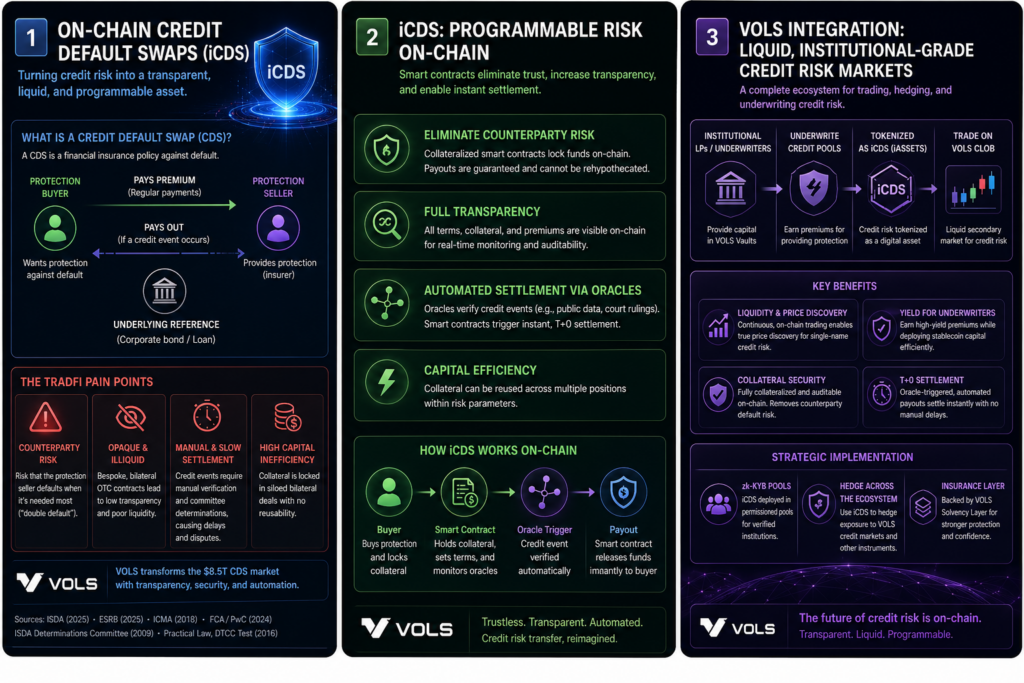
A CDS is essentially a financial insurance policy against default. It is a bilateral (two-party) contract used for hedging, speculation, or risk transfer. The buyer, somebody who wants protection, pays a regular premium to the seller similar to an insurance fee. The seller, usually an underwriter, receives said premium and agrees to pay the buyer the face value of the underlying debt (this could be a corporate bond or a loan) if the debt defaults or experiences a specific “credit event”.
The TradFi Pain Points
The traditional OTC market for single-name CDS is plagued by structural issues. The first being the counter party risk. The buyer takes the risk that the seller (insurer) might default simultaneously (“double default”) right when the protection is needed most. Secondly most CDS contracts are bespoke, private deals, leading to incomplete transparency and low liquidity for single-name entities (ESRB, 2025; ICMA, 2018). This makes true price discovery difficult. Thirdly, determining if a credit event has occurred and settling the payment often relies on manual processes and centralized committees, creating delays and disputes (ISDA Determinations Committee, 2009).
iCDS as Programmable Risk
The logic of a CDS follows a binary outcome (default/no default) tied to a verifiable event. It is perfectly suited for smart contracts. On-chain iCDS protocols eliminate the need for trust between counterparties as smart contracts can act as an intermediary. The iCDS contract itself holds the collateral for both the buyer and seller. The seller’s capital is locked on-chain, ensuring the payout is guaranteed (or collateralized) and cannot be touched by the seller, removing traditional counterparty default risk (Practical Law, DTCC Test, 2016). Furthermore, all collateral, premiums, and rules are publicly visible on the blockchain, addressing the “incomplete post-trade transparency” issues noted by the FCA and others (FCA/PwC, 2024).
Following this, the iCDS can bring automated and instant settlement that is triggered by oracles. A traditional credit event requires manual verification and committee determinations. Also on-chain iCDS relies on oracles (e.g. chainlink feeds reporting objective borrower performance or public court data) to automatically determine if a default has occurred. Then upon verified trigger, the smart contract instantly releases the necessary funds from the collateral pool to the protection buyer, eliminating the weeks or months of delay common in traditional settlement processes.
The VOLS Integration
The VOLS platform, featuring a native Solvency Layer, is designed to transform the complex credit default swap (CDS) market into a liquid, institutional-grade asset class. Institutional Liquidity Providers (LPs) would utilize our vaults to function as protection sellers, underwriting specified credit pools in exchange for a premium. This credit exposure is then tokenized as an iAsset, which serves as a tradable security. Acquired iAssets can be traded via the Central Limit Order Book (CLOB), establishing a continuous and liquid secondary market for credit risk. This mechanism resolves the illiquidity issue currently plaguing the single-name CDS market. Underwriters generate yield from the collected premiums while deploying their stablecoin capital effectively. This presents institutional funds with a novel, high-yield investment opportunity outside of traditional asset classes.
Strategic Implementation
VOLS integrates this into its broader framework for institutional adoption. These iCDS contracts can be deployed exclusively within zk-KYB (Know-Your-Business) pools, ensuring that the counterparties trading credit risk are vetted institutions, satisfying regulatory compliance demands. Furthermore you can purchase iCDS protection to hedge exposure to other VOLS markets, such as the tokenized credit tranches listed on our CLOB, creating a single, insured ecosystem.
By replacing the opaque, manual OTC world with a transparent, T+0, and fully collateralized digital contract, VOLS offers a powerful and secure solution for credit risk transfer in the 21st century.