Rebuilding the Repo Market on VOLS
The repurchase (repo) market, with over $15 trillion in daily transactions, is the circulatory system of modern finance. It’s the critical, behind-the-scenes engine where banks, money market funds, and corporations exchange high-quality collateral for short-term cash. But despite its importance, this market operates on decades-old infrastructure that creates hidden costs, risks, and inefficiencies.
VOLS is built to change that, offering a fundamentally better way to conduct these essential transactions. We’re not just making the repo market faster; we’re rebuilding its core workflow on a modern, transparent, and hyper-efficient DeFi platform powered by Hedera..
What exactly is the Repo Market?
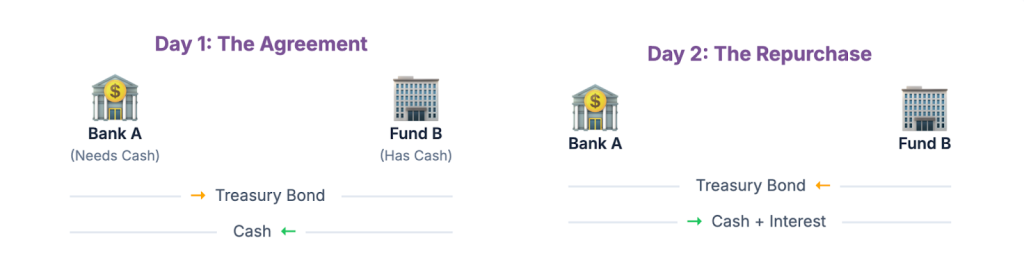
For those unfamiliar, the repo market is best understood as a sophisticated pawn shop for financial institutions.
An institution (like a bank) that needs cash for a short period, often overnight, will “sell” a highly secure asset it owns (like a U.S. Treasury bond) to another institution (like a money market fund) with cash to spare. Crucially, they simultaneously agree to repurchase that same asset the next day at a slightly higher price.
The difference between the initial sale price and the repurchase price acts as the interest paid to the cash lender. This allows institutions to get vital short-term liquidity without having to permanently sell their core assets. It’s the engine that keeps the financial system’s daily cash needs met.
The Traditional Repo Workflow:
The current process is a complex, multi-step dance between different institutions, each with its own separate record-keeping system. This friction is the source of the market’s biggest problems.
The Traditional Workflow in Action:
- Off-Chain Agreement: Bank A and Fund B agree on terms (collateral, rate, duration) over a messaging system or phone call.
- Separate Instructions: Both parties send manual instructions to their respective custodians and clearing banks.
- Collateral Moves on Rail #1: A Central Securities Depository (CSD) or a Clearing House like the DTCC moves the Treasury bond on its private ledger.
- Cash Moves on Rail #2: A settlement system like Fedwire moves cash on a completely separate banking ledger.
- End-of-Day Reconciliation: The trade isn’t final until the next day (T+1). All parties must reconcile their separate books to ensure everything arrived as expected.
- The Unwind: The next day, the entire process is done in reverse, requiring a new set of instructions and transfers.
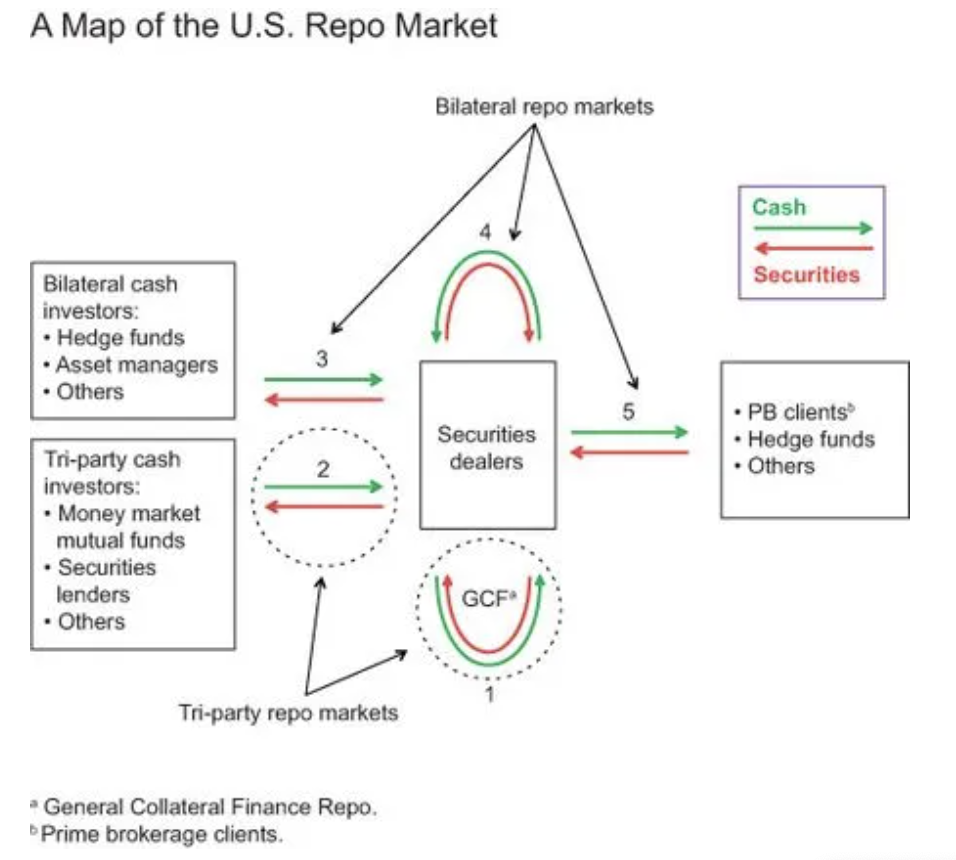
Image from Liberty Street Economics: https://libertystreeteconomics.newyorkfed.org/2012/06/mapping-and-sizing-the-us-repo-market/
This workflow is defined by its fragmentation. Cash and collateral move on different systems, requiring constant reconciliation and creating settlement risk—the danger that one side of the trade will complete while the other fails.
How DeFi Will Help
Decentralized Finance (DeFi) offers a powerful new model by representing traditional assets like Treasury bonds as digital tokens on a single, shared ledger (a blockchain). This allows us to collapse the fragmented traditional workflow into one seamless, automated process.
It’s not just about being “faster” or “more transparent”—it’s about fundamentally changing how the trade is settled.
The DeFi-Powered Workflow on VOLS:
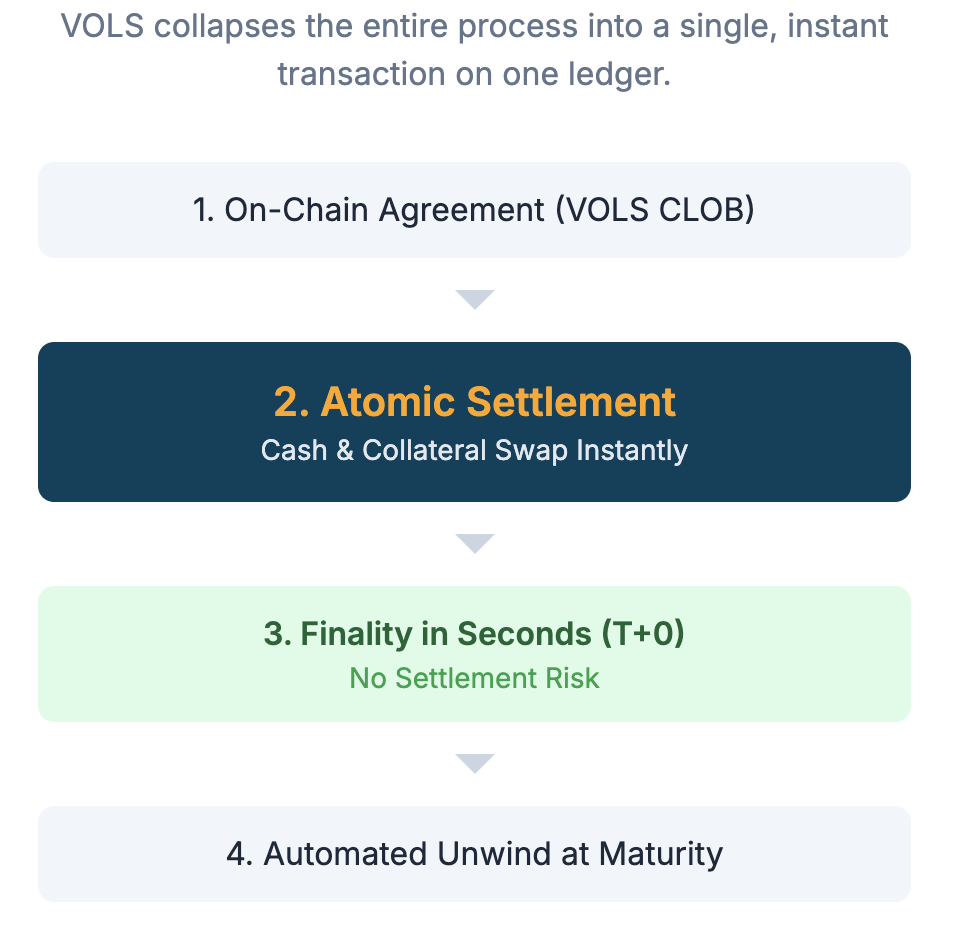
- On-Chain Agreement: Bank A connects its institutional digital wallet, holding its tokenized Treasury bond, to the VOLS platform. It places an order on a transparent, real-time marketplace (the CLOB), which is instantly matched with Fund B’s order to lend cash.
- Atomic Settlement:. A smart contract, a self-executing digital agreement, executes the entire trade in a single, indivisible transaction.
- The tokenized Treasury bond moves from Bank A’s wallet to Fund B’s wallet.
- The digital cash (e.g., USDC) moves from Fund B’s wallet to Bank A’s wallet.
- This happens at the exact same moment on the same ledger. If either part of the transaction fails, the entire trade instantly reverts. It completely eliminates the settlement risk inherent in the two-rail system.
- Instant and Automated State: The trade is final in seconds (T+0). The shared on-chain ledger becomes the single source of truth for ownership, eliminating the need for manual, end-of-day reconciliation.
- Automated Unwind: At maturity, the smart contract automatically executes the repurchase. It returns the tokenized bond to Bank A and the principal plus interest to Fund B. No new instructions or intermediaries are required.
VOLS: The Institutional-Grade Infrastructure for On-Chain Repo
This new workflow requires a platform built for the rigorous demands of institutions. VOLS provides the complete, vertically integrated stack to make this possible:
- A Fair and Transparent Marketplace : At our core is an on-chain Central Limit Order Book, modeled after those on the NYSE or NASDAQ. It ensures fair price discovery and deterministic execution, visible to all parties.
- Programmable Liquidity: Institutions can deposit assets into VOLS Vaults, which are smart contracts that automatically execute predefined repo strategies, putting idle capital to work safely and efficiently.
- Built-in Capital Protection: Our native insurance layer allows participants to underwrite or purchase protection against specific risks, such as counterparty default, providing the security needed for large scale adoption.
Putting It Into Practice: A Real-World Scenario
- Tokenization: Bank A tokenizes £100M of its UK government bonds (gilts) with a regulated partner.
- Liquidity Provision: Fund B deposits regulated digital dollars (USDC) into a VOLS repo Vault to earn a safe yield.
- Execution: Bank A posts its tokenized gilts to the VOLS marketplace. A smart contract instantly matches them with Fund B’s liquidity, executing the trade at T+0.
- Protection: The transaction is backed by the VOLS insurance layer, mitigating counterparty failure risk.
- Settlement: The next day, the smart contract automatically unwinds the trade, returning the collateral and principal plus interest with a fully auditable on-chain record.
The Strategic Imperative
The benefits of moving on-chain are too significant to ignore. By providing the first truly institutional-grade infrastructure for this new market, VOLS isn’t just offering a better way to trade repo; it’s laying the foundation for a more resilient, efficient, and transparent global financial system.
VOLS offers institutions a unique opportunity: the ability to access on-chain yield, execution, and governance, without surrendering control, transparency, or risk management.
It’s the first DeFi-native infrastructure to bring together:
- The execution discipline of a regulated exchange
- The flexibility of programmable liquidity strategies
- The safety of native insurance and governance