Automated Delta-Neutral Vaults: The Future of Portfolio Hedging
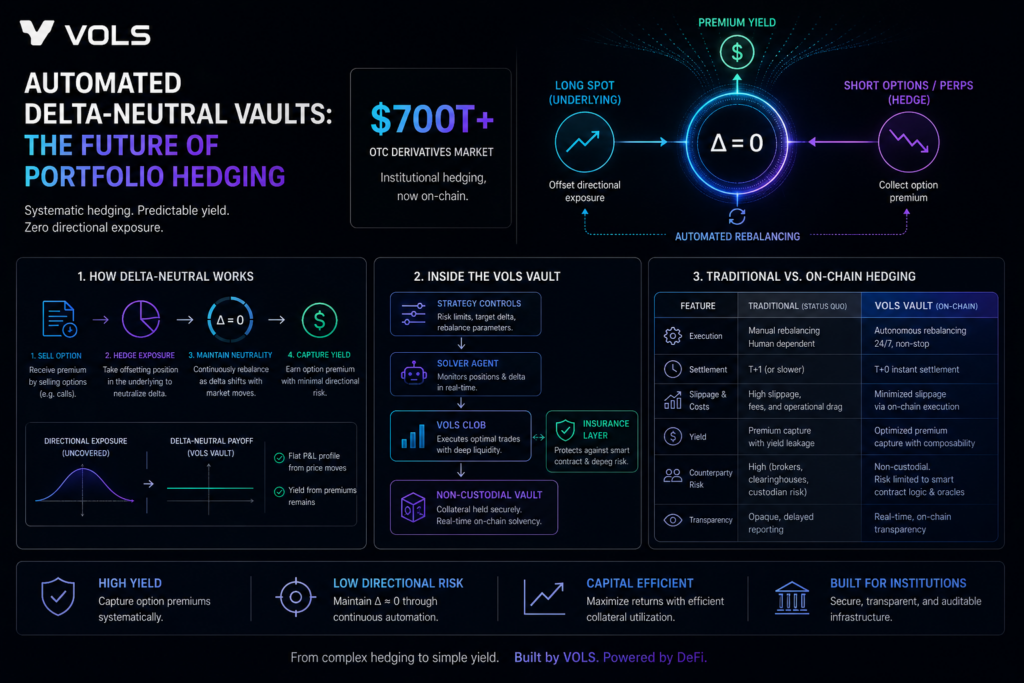
For institutional investors, volatility is the constant enemy of predictable yield. The global market for over-the-counter (OTC) derivatives (i.e. the primary venue for managing risk) has a staggering notional value estimated near $700 trillion. Yet, the execution of critical hedging strategies, particularly delta hedging, remains a manual, complex, and costly process. This manual reconciliation and management force institutions to spend enormous sums annually, consuming the very yield they seek to generate. Decentralized finance (DeFi) is transforming this by automating complex hedging into secure, single-click products called Delta-Neutral Vaults, offering a clean break from the slow, friction-filled operations of the past.
What is Delta Hedging?
Delta hedging is a risk management strategy used to insulate a portfolio from small price movements in the underlying asset. It is a core tactic for market makers, derivatives issuers, and funds seeking to earn premium income (yield) without taking on directional risk.
The Core Mechanism
- Delta Defined: Delta measures how much the price of a derivative (like an option) is expected to change for a given $1 change in the underlying asset’s price.
- Neutrality: A delta-neutral strategy ensures the entire portfolio’s net delta is zero. This is achieved by taking an opposing position in the underlying asset. For example, if a fund sells an option with a delta of +0.5 (meaning the option gains 50 cents if the stock rises $1), the fund must short 0.5 shares of the underlying asset to achieve neutrality. .
- The Yield: The investor profits by capturing the premium received from selling the option, while minimizing exposure to the price of the underlying asset.
The TradFi and Early DeFi Problem
The execution of the delta hedging strategy presents significant challenges in both traditional and early DeFi environments. The core difficulty lies in manual rebalancing, as the asset’s delta constantly shifts with price movements, requiring continuous buying or selling of the underlying asset to maintain neutrality. This labor-intensive process is costly and introduces slippage and latency; for instance, in early DeFi, high gas fees and execution slippage frequently eroded the premium captured, fundamentally undermining the strategy’s profitability. Furthermore, relying on traditional systems introduces centralized risk, as trading options requires trusted third-party brokers or clearinghouses, thus exposing the fund to counterparty failure.
The DeFi Solution: Automated Delta-Neutral Vaults
Portfolio Hedging Vaults are smart contracts designed to perform the continuous, automated rebalancing necessary for delta neutrality.
A. Non-Stop, Trustless Automation
These Vaults utilize specialized algorithms and automated agents to monitor the delta of the options sold. When the delta deviates from zero (e.g., the position becomes net long or short), the Vault’s internal agent instantly executes the necessary spot market trade on the VOLS CLOB to return the portfolio to neutrality. By moving execution on-chain, gas fees and slippage are minimized, drastically reducing the operational drag associated with manual rebalancing, which is a major benefit over traditional systems. The collateral backing the options is held in the non-custodial Vault, and its solvency can be verified in real-time, removing the traditional reliance on centralized counterparty risk.
B. The Future: Composable Hedging
The future of these vaults lies in their composability and the ability to connect with other DeFi primitives to create complex, multi-layered risk management strategies (Coingecko, 2024).
Institutions can use these vaults not just to sell options, but to hedge the directional exposure of complex yield-generating assets like tokenized bonds or liquidity provider (LP) positions in Automated Market Makers (AMMs). This is a level of instantaneous, granular risk management that is practically impossible in TradFi. Fund managers can delegate capital to these audited, policy-constrained Vaults, effectively turning complex active hedging into a passive, yield-generating investment product—a key requirement for attracting large institutional funds.
High Yield, Low Directional Risk
Automated Delta-Neutral Vaults transform institutional risk management from a cumbersome cost center into a high-efficiency yield generator.
The contrast between the traditional and on-chain models reveals the fundamental advantages of DeFi for institutional hedging. In the traditional status quo, execution is manual, suffers high slippage, and settles slowly on a T+1 basis. Conversely, the VOLS Vaults offer automated, atomic execution with instant T+0 settlement enforced by smart contracts. This automation is complemented by superior yield generation: traditional systems are limited to premium capture and are prone to operational leak, whereas on-chain Vaults optimize premium capture and boost yield through composability and highly efficient collateral use. Crucially, the risk profile is dramatically different: TradFi carries high Counterparty Risk stemming from broker or custodian failure, while the non-custodial nature of VOLS means risk is confined to verifiable smart contract logic and price feed integrity.
The ability to generate yield from options premiums while algorithmically neutralizing market exposure offers an attractive, risk-adjusted return profile. This innovation, integrated with the security of the VOLS stack, positions on-chain delta hedging as an indispensable tool for the next wave of institutional capital.