Decentralized Finance (DeFi) offers a radically efficient, transparent, and autonomous infrastructure for capital markets. But for institutions, its greatest strength is also its greatest liability.
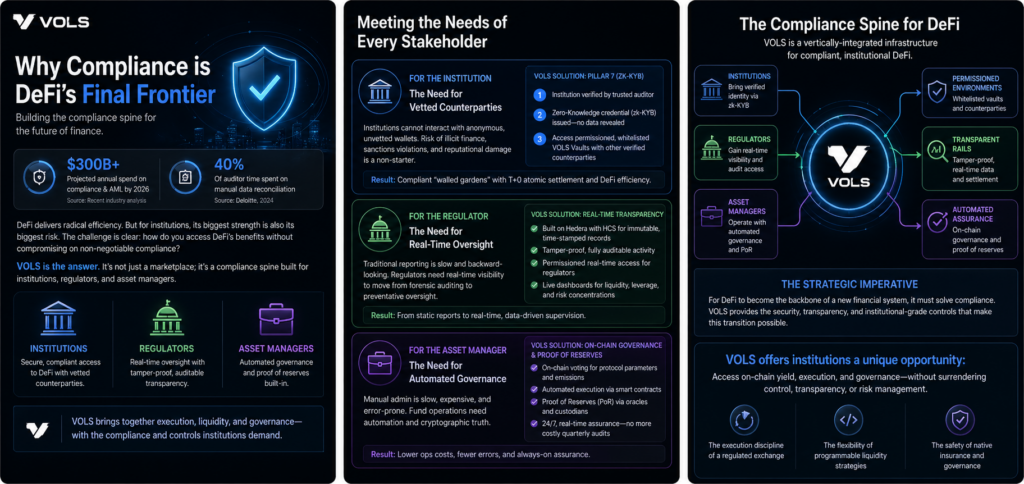
In the traditional world, finance runs on trust, but that trust is enforced by a massive, costly, and often manual compliance apparatus. Financial institutions are projected to spend over $300 billion annually on compliance and Anti-Money Laundering (AML) checks by 2026, according to recent analysis. They face a critical dilemma: how to access DeFi’s clear technological benefits without violating their core, non-negotiable regulatory mandates?
The answer is not to force DeFi into old-world boxes. It’s to build new, digitally native compliance infrastructure from the ground up. VOLS is not just a marketplace; it is a compliance spine designed to solve the distinct pain points of every stakeholder in the institutional ecosystem.
For the Institution: The Need for Vetted Counterparties
A Chief Compliance Officer at a major bank simply cannot permit the firm’s capital to interact with anonymous, unvetted wallets in the open “degen” space. The risk of illicit finance, sanctions violations, and severe reputational damage is an absolute non-starter.
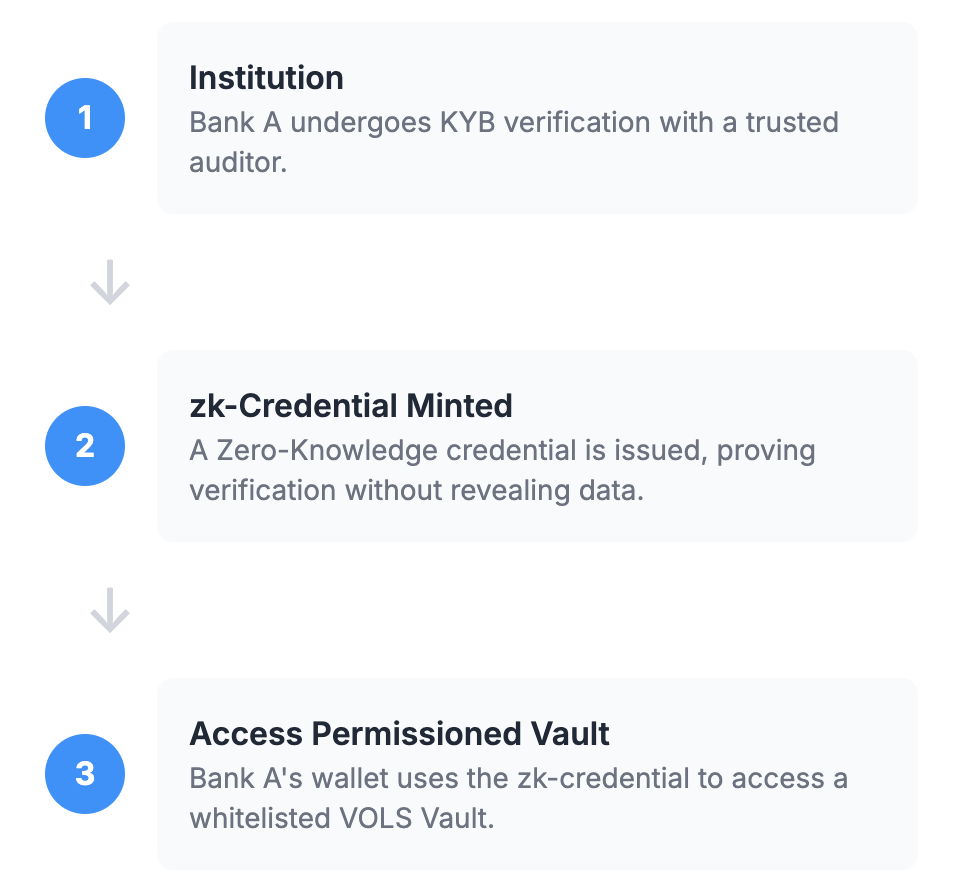
VOLS is designed with “compliance hooks” that allow institutions to create secure, permissioned environments that leverage public, decentralized rails. This is based on Pillar 7 of the VOLS framework. We are building a framework for Zero-Knowledge Know Your Business (zk-KYB). This allows an institution to prove it has been vetted by a trusted verifier (e.g., a “Big Four” firm) without revealing its sensitive corporate identity or transaction data publicly on-chain. Using these “zk-credentials,” institutions can create private, whitelisted Vaults where participation is restricted only to other verified zk-KYB counterparties. This creates a compliant “walled garden” that still benefits from the T+0 atomic settlement and automated efficiency of DeFi.
This model solves the institution’s dilemma, enabling compliant interaction without sacrificing the core technological benefits.
For the Regulator: The Need for Real-Time Oversight
Regulators today operate in a reactive, backward-looking paradigm. They rely on periodic reports filed by institutions, often months after the fact. As a 2024 report by Deloitte noted, auditors can spend up to 40% of their time on manual data reconciliation, a process that is slow, expensive, and fails to provide a real-time view of systemic risk.
VOLS is built on Hedera, which uses the Hedera Consensus Service (HCS) to log all critical transactions and state changes. This creates a tamper-proof, time-stamped, and fully auditable record of all activity, accessible to permissioned parties (like regulators) in real-time. The Bank for International Settlements (BIS) itself noted in a 2024 paper that while DeFi presents risks, its “inherent transparency” could offer “new tools for real-time monitoring of systemic risk.” Instead of receiving a static PDF report, a regulator could access a live dashboard of aggregated, anonymized market activity on VOLS. They can see real-time liquidity, leverage ratios, and risk concentrations as they build, moving from forensic auditing to preventative oversight.
For the Asset Manager: The Need for Automated Governance
Traditional corporate governance and fund administration are slow and expensive. Fund administrators spend billions each year on the manual, error-prone processes of proxy voting, NAV calculation, and dividend distribution. VOLs provides the solution of on-chain governance & proof of reserves
VOLS automates these functions, replacing manual administration with cryptographic truth. Our VOLS governance token will allow stakeholders to vote on protocol parameters and emissions. The results are instantly tallied and executed by smart contracts, eliminating ambiguity and administrative overhead. For any tokenized RWA or vault on the platform, VOLS’s infrastructure can integrate Proof of Reserve (PoR) feeds from oracles and custodians. This allows an asset’s backing to be verified cryptographically in real-time, replacing the need for costly quarterly audits with 24/7, automated assurance.
The Strategic Imperative: The Compliance Spine
For DeFi to graduate from a niche, speculative market to the backbone of a new financial system, it must solve compliance. VOLS is engineered to be the compliance spine that makes this transition possible, providing the security, transparency, and institutional-grade controls that all stakeholders require.
VOLS offers institutions a unique opportunity: the ability to access on-chain yield, execution, and governance, without surrendering control, transparency, or risk management.
It’s the first DeFi-native infrastructure to bring together:
- The execution discipline of a regulated exchange
- The flexibility of programmable liquidity strategies
- The safety of native insurance and governance